
MLC Insider Intelligence: October 30, 2026
Michigan Legislative Consultants
Weekly ecap: Neither the House nor Senate held session this week.
Ballot Proposals Before Voters: This year, Michigan voters have two statewide ballot proposals they will vote on in the general election. While vastly different, both could have major impacts on the Michigan Constitution and campaign finance laws in the state.
Proposal 1 - Constitutional Convention: Under the current Michigan Constitution, every 16th year, the question of holding a convention to amend the state’s constitution must be automatically placed on the general election ballot. If adopted, this would open the entire constitution to be potentially changed, which could have wide-reaching ramifications. Any changes a constitutional convention agrees upon would be placed before Michigan voters to approve. The last time this question was before voters in 2010, 66% of people voted against holding a convention. The proposal also failed the prior two times this question was placed before voters.
Proposal 2 - Michiganders for Money Out of Politics: Under this citizen-initiated proposal, companies with state or local contracts over $250,000 would be prohibited from donating money to politicians or related political groups. Regulated utilities would also be prohibited from making political contributions. In addition to campaign donations, the proposal would limit companies from funding ads or communications discussing issues, even if they don’t directly tell viewers how to vote. Should this pass, opponents of the statutory change have indicated they would file a legal challenge.
Michigan Voters Continue to Cast Ballots: With one week left until the General Election, 18.8% of active registered voters have cast their ballot. In Michigan, 1,392,170 ballots have been cast; of those, over 1.1 million were via a mail ballot.
Early Voting: This is the first midterm statewide general election with early in-person voting available for every Michigan voter. It opened on October 24, and as of October 27, 215,795 voters have cast a ballot at one of the locations. Early voting will continue through Sunday, November 1, for at least eight hours every day.
Voter Data: As of October 27, 2,154,870 mail ballots have been requested, which is higher than one week prior to the 2022 election total of 1,899,273. Likewise, returned ballots have grown since the last midterm election. Thus far, 1,176,375 ballots have been returned, versus 1,126,246 in 2022.
Education Gap Research Shared: The Michigan Department of Lifelong Education, Advancement, and Potential released a new study examining the growing education gap between men and women. The report’s findings were discussed during a virtual panel discussion featuring the department, Governor Gretchen Whitmer, legislators, officials from the Department of Education and the Department of Labor and Economic Opportunity, among other stakeholders.
Research Highlights: “Moving Michigan Males Forward: The Next Steps” examined the challenges and opportunities to strengthen engagement in education and career pathways amongst boys and men. While Michigan has made significant progress in expanding access to higher education and career training, women continue to outpace men in several key measures of educational participation and attainment. Researchers and education leaders point to a range of factors that may influence men’s decisions to pursue education after high school, including financial pressures, uncertainty about career options, limited exposure to postsecondary pathways, and the need to enter the workforce quickly.
Importance: According to the Michigan Center for Data and Analytics, approximately 50% of Michigan women ages 25 to 64 held an associate degree or higher, compared to just over 41% of men. Nationally, women earned approximately 58% of bachelor’s degrees in 2021, while men earned 42%.
Crime Rate Declines: Governor Gretchen Whitmer announced that violent crime in Michigan is the lowest it’s been in seven years. Murders are down more than 40% since 2021, robberies have been cut in half, and more than 1,000 illegal guns have been taken off the streets.
State Investment: The governor points to years of sustained investment, including $100 million for Public Safety Revenue Sharing grants over the past two fiscal years, to provide cities, villages, and townships with additional resources for police services and to support community violence intervention efforts. Additionally, recent appropriations of $25.2 million for community violence intervention efforts, $2.5 million for a statewide gun violence prevention task force to save lives, reduce violence, and work to keep residents safe, and a 20% pay raise for Michigan State Police Troopers and Sergeants to attract and retain forces.
Auditor General Retiring: After 39 years in State Government, Michigan Auditor General Doug A. Ringler announced he will retire in the spring of 2027. He’s served in his current role since 2014 and previously served as the State’s director of internal audit and financial reporting manager, among other duties. Mr. Ringler will work with legislative leadership and staff to ensure a smooth transition to a new Auditor General.
The Office of the Auditor General: The office was created in 1836 as an elected office. Under the Michigan Constitution of 1963, it shifted to an appointment by a majority vote of the legislative members. The Auditor General is responsible for post-financial and performance audits of all branches, departments, offices, boards, authorities, and other institutions within state government. Once completed, the audit reports are public documents.
Next Week: The General Election will be held on Tuesday, November 3. The Senate has scheduled session for Wednesday and Thursday, while the House has scheduled session for Thursday. Following the General Election, the House and Senate will hold leadership elections to elect their party leaders for the upcoming 2027-2028 legislative term.
Congratulations to MLC President Tim Ward on his 24th anniversary at the firm!
Leading up to the November 5 general election, we are highlighting races generally considered swing seats.
General Election Overview: Secretary of State: Due to term limits, Michigan Secretary of State Jocelyn Benson is ineligible to run for reelection, leaving this race open. The race to succeed her is between Democratic Lt. Governor Garlin Gilchrist II and Republican Macomb County Clerk Anthony Forlini. The Lt. Governor entered the race in January after ending his campaign for governor. Both he and Mr. Forlini were officially nominated by their respective parties at their nominating conventions.
In Michigan, the Secretary of State heads the Department of State, which encompasses a myriad of responsibilities. The secretary serves as both the chief motor vehicle administrator and chief election officer. In that role, they have authority over the election processes, vehicle registrations, and the licensing of drivers. Additionally, the secretary administers driver education and traffic safety programs, is the Keeper of the Great Seal, and manages the notary public program. In the event of vacancies or absence from the state of the governor and lieutenant governor, the Secretary of State serves as governor. As Michigan’s chief election official, both major parties see this race as pivotal, especially since the winner will oversee the 2028 presidential election in one of the nation’s key battleground states.
Democratic Candidate:
Lt. Governor Garlin Gilchrist – Lieutenant Governor and software engineer.
Republican Candidate:
Anthony Forlini – Macomb County Clerk, former state representative and Harrison Township Supervisor, and small business owner.
Libertarian Candidate:
Christine Sloan
U.S. Taxpayers Candidate:
Scott Aughney
Green Candidate:
Eric Borregard
General Election Overview: Attorney General: Current Attorney General Dana Nessel is serving her second and final term in office. The Attorney General serves as Michigan’s top lawyer and law enforcement official. They oversee a department comprised of more than 500 lawyers, investigators, and other employees. This year’s race features two sitting county prosecutors.
Democratic candidate Eli Savit, the Washtenaw County Prosecutor, is running to succeed term-limited Attorney General Dana Nessel and keep the office in Democratic hands. The Democratic Party held the office for 42 consecutive years, from 1961 to 2003, before Republicans controlled it for the next 16. Attorney General Nessel flipped the office back to the Democrats in 2019. Republican Doug Lloyd, the Eaton County Prosecutor, is looking to win it back for his party.
Democratic Candidate:
Eli Savit – Washtenaw County Prosecutor, attorney, served as senior legal counsel for the City of Detroit, and former public school teacher. He clerked for United States Supreme Court Justices Sandra Day O’Connor and Ruth Bader Ginsburg.
Republican Candidate:
Doug Lloyd – Eaton County Prosecutor, attorney, and former Eaton County Chief Assistant Prosecuting Attorney and Assistant Prosecuting Attorney.
Libertarian Candidate:
Jason Dye
U.S. Taxpayers Candidate:
John Perry Ludtke, Jr.
Green Candidate:
Jeff Polonowski
Natural Law Candidate:
Doug Dern
General Election Overview: The Race for Governor of Michigan: After serving two terms, Democratic Governor Gretchen Whitmer is term-limited and cannot run for reelection. She handily won the 2022 general election 54.5% to Republican candidate Tudor Dixon’s 43.9%. Michigan is a true purple state, and the governor has flipped back and forth between the two major parties for decades. If the trend continues, that will benefit Republican candidate Congressman John James. However, because the national political environment appears to favor Democratic candidates, that could help push Secretary of State Jocelyn Benson over the finish line in November.
In recent weeks, public polling has shown Secretary Benson leading by roughly 3 to 7 points, depending on the poll, with polling averages putting her ahead by about 6. Public reporting also shows the Benson campaign and its allies significantly outspending the James campaign. Although the governor’s race sits at the top of the ticket in Michigan, it’s worth noting that the U.S. Senate race between Mike Rogers and Abdul El-Sayed has drawn most of the media and fundraising attention.
As we head toward Election Day, Secretary Benson appears to have the lead, but a comeback by Congressman James is still within striking distance.
Democratic Candidate:
Secretary of State Jocelyn Benson – Michigan Secretary of State, attorney, and former Dean of Wayne State University Law School.
Lt. Governor Running Mate: Senator Winnie Brinks – Senate Majority Leader, former state representative, and worked as a caseworker at The Source and as director of a community-based corrections agency.
Republican Candidate:
Congressman John James – Congressman, Veteran, and led his family’s company, the James Group International and Renaissance Global Logistics.
Lt. Governor Running Mate: Representative Jay DeBoyer – State Representative, small business owner, and former clerk and register of deeds for St. Clair County and Clay Township trustee and supervisor.
Libertarian Candidate:
Anthony Hudson
Lt. Governor Running Mate: Beau Permenter
U.S. Taxpayers Candidate:
Donna Brandenburg
Lt. Governor Running Mate: Robert Cowper
Green Candidate:
Douglas Campbell
Lt. Governor Running Mate: Bobbie Clay
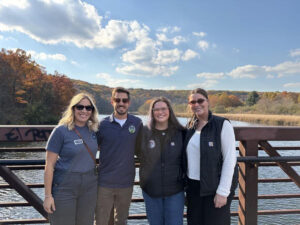
This week, MLC lobbyist Emily Simmons brought together Jolie Lawrence and Kylie Spagnuolo from Governor Whitmer’s team to join our client, the Huron Waterloo Pathways Initiative, for a fall walk on the Border to Border Trail.