
The Pulse in Missouri Politics: August 30, 2025
Gamble & Schlemeier
What’s in this Edition?
- Top Three Takeaways of the Week
- Deeper Dive into Top Issues
- Historical Data on IPs
- Quick Links
- Trending Headlines
- Lobbyist Changes
- Campaign Contributions Over $5K
- Calendar
Top Three Takeaways of the Week
- Blockbuster Special Session Call: Governor Kehoe called a special session beginning September 3 to tackle congressional redistricting and proposals to change Missouri’s initiative petition process. Read more
- New Laws in Effect: Dozens of new laws passed during the 2025 legislative session took effect August 28, including new requirements for Political Action Committees (SB 152), utility disconnection protections in extreme weather, and tax exemptions for diapers and menstrual products. Read more
- MO as Global Hub for Innovation: Governor Kehoe promoted Missouri as a global hub for health innovation at the BioSTL Health Summit, highlighting St. Louis’s purchasing power and announcing plans for a new Center of Excellence for Rural Health Care.
Download G&S Guide to Bills Passed in 2025
Deeper Dive into Top Issues
Blockbuster Special Session Called
A second special session has been called by the Governor to address recrafting the congressional districts in the state and, perhaps most surprisingly, to also address IP reform. This is not a stock offering but instead “initiative petition” reform.
The President has called on states to reformulate their congressional districts to squeeze out additional Republican seats in order to help him hold the majority in Congress in the 2026 elections. This was widely expected in the hallways of the Capitol. Missouri currently has eight congressional seats: six Republican and two Democratic. The new map, which will be revealed soon, will attempt to shift the balance to seven Republicans and one Democrat, unseating incumbent Emanuel Cleaver (D-KC). Voters will ultimately decide that outcome.
The real surprise is the announcement that IP reform will also be part of this special session (which will run concurrently with the upcoming veto session). We have not yet seen the proposal; however, the goal is to raise the bar for passing amendments to the state constitution. Some proposals would require more than a simple majority, such as raising the threshold to 55% approval. Others would require both a simple majority of the statewide popular vote and a majority of congressional districts (five of eight) to approve the measure. Finally, one idea being floated is that voters in all eight districts would each have to approve the measure by a simple majority.
Oddly enough, these two issues may not generate the most heated debate during the special session. Instead, the real conflict could center on the procedure used to pass them. Invoking the “PQ” (previous question) in the Senate ended the regular session last May, when it was used on back-to-back issues (abortion and repeal of paid sick leave). This remains a major point of friction between Republicans and Democrats. If the PQ is used twice more in this special session, “putting the puzzle back together again,” according to Democrats, could prove challenging.
Political Action Committees (PACs) Have New Rules
SB 152, passed last session, contains new administrative requirements for contributors to and treasurers of PACs. According to the Missouri Ethics Commission, every contributor to a PAC must now submit a form stating that they do not meet certain criteria, in an effort to keep “foreign” money out of elections.
The law took effect on August 28. As a result, all future contributions to PACs and all reports filed by PACs are now subject to the new requirements. The legislation further states that the Attorney General, not the Missouri Ethics Commission, will be responsible for enforcement.
The Commission has issued guidance in a timely manner. However, it remains unclear whether the Attorney General’s office shares the same interpretation of the law.
Kehoe Highlights Missouri as Global Health Innovation Hub
Improving health care in rural and underserved urban areas was the focus of the BioSTL Health Summit, attended by innovators from around the globe along with government consulate members from several countries.
In his speech, the Governor promoted Missouri as a leading health care hub, highlighting St. Louis as having the second largest health care purchasing power in the nation. Kehoe emphasized that Missouri brings both purchasing power and brain power to help test and bring new technology to market, ultimately delivering better and more timely health care.
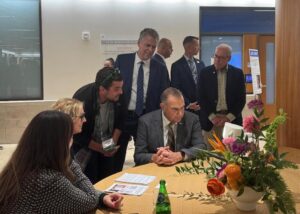
While in attendance, he and the First Lady, Claudia Kehoe, viewed several new technologies, including a robot he interacted with in the photo below. This ninth annual conference served as the catalyst for creating a Center of Excellence for Rural Health Care, comprised of stakeholders worldwide. Kehoe’s remarks were heard by representatives around the globe and helped solidify the center’s formation.
Historical Data on Ballot Measures
For more than a century, Missouri voters have shaped public policy directly at the ballot box. From pensions for the blind in 1916 to marijuana legalization in 2022, the initiative and referendum process has been a powerful tool for both citizens and lawmakers. As debate continues over potential reforms to this process, here are five key facts from the state’s ballot history that put today’s conversation in context:
- 420 statewide measures have gone before Missouri voters since 1910 — ranging from taxes and infrastructure to health care and social issues.
- Overall, fewer than half have passed (46%), though passage rates have surged to more than 70% in the last 20 years.
- General Assembly referrals have historically fared better than citizen-led initiatives — but in recent years, both have passed at nearly the same high rate.
- The margins can be razor-thin: Amendment 1 (“Right to Farm”) passed in 2014 by just 0.24%, one of the closest statewide results in history.
- The first initiative petition in 1910 sought to ban alcohol and failed; the first successful measure came in 1916, when voters approved pensions for the blind.
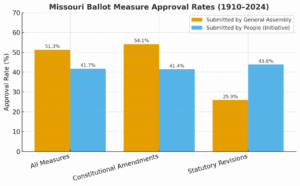
KEY
- Legislative Referral (General Assembly ➝ Ballot ➝ Voters Decide)
- Initiative Petition (Citizens ➝ Ballot ➝ Voters Decide)
Referendum (Legislature passes law ➝ Citizens challenge ➝ Voters Decide)
Quick Links
- FY2026 Department Requests
- Bills Signed by the Governor
- Emergency Rules
- House & Senate Rosters
- New RFPs
- New Proposed State Regulations
- MEC Ethics Guide 2025
- Legislator Lookup
Trending Headlines
- How will Missouri’s cannabis market change if the feds reschedule marijuana?(Missouri Independent)
- Trump’s big, beautiful bill: states face shortfalls on eve of changes (Axios)
- Cole County judge denies request to freeze Missouri private-school voucher payments (Missouri Independent)
- Rural OB-GYN closures leave Missouri families with fewer options (The Beacon)
- Navigating the repeal: Employer FAQ on paid sick leave changes (Missouri Chamber)
- Missouri becomes first state to repeal capital gains tax, at an estimated $625M cost (Missouri Independent)
- ‘We are sweating’: Missouri kindergarten vaccination rates fall below immunity threshold (Missouri Independent)
- St. Louis County Council tweaks senior property tax freeze (St. Louis Post-Dispatch)
- Dome at America’s Center faces $67M funding gap, audit finds (St. Louis Business Journal)
- Missouri judge weighing whether new abortion ban should appear on 2026 ballot(Missouri Independent)
- Missouri enacts new laws (Columbia Missourian)
- Missouri audit finds flaws in Rams riverfront stadium planning (St. Louis Business Journal)
- Lawsuits challenge ‘deceptive’ summaries for Missouri public education ballot measures (Missouri Independent)
Lobbyist Changes
- Doug Richey added ADF Action.
- Ryan DeBoef added Highway 60 Corridor LLC.
- Gamble & Schlemeier deleted Missouri Collectors Association.
- James Harris added California Opulence.
- Ginger Steinmetz added Midway Sports, LLC.
- Ryan McKenna added Missouri AFL-CIO; and deleted St. Louis Community College.
- Gamble & Schlemeier deleted Missouri Coalition for Lifesaving Cures.
Source: Missouri Ethics Commission
Campaign Contributions Over $5,000
|
Source: Missouri Ethics Commission
Calendar
September
10 – Veto Session